sandustry · sandustry processing plant
Sandustry Processing Plant: Setup Guide
Last verified: 2026-08-15
A Sandustry processing plant is not a building — it is the whole conversion chain laid out so physics can do the work: Sand meets Water to become Wet Sand, shakers split that into Gold and Slag, fire turns slag into Burnt Slag, and the Kinetic Slag Press turns that into more gold plus spores. Plants fail silently — shakers idle while you dig, wetting pools run dry, slag swallows a belt — so this page is about architecture: the zones every Sandustry processing plant needs, the flow rules that keep them honest, and the ratios worth a sanity check before you expand.
The four zones
Long-form factory runs that stay organized tend to converge on the same floor plan, and nearly every recorded Sandustry processing plant shares four zones:
- Intake and storage — everything dug lands in one oversized box (or row of boxes) for unsorted material. Nothing is processed straight from the mine face.
- The main line — a single conveyor spine carries the mixed stream past filter stages. Each stage peels one material off into its own container, exactly like the "main bus" pattern factory veterans import from other games: one line, filters doing the sorting, every resource with a home.
- Processing wings — wetting pool, diagonal shaker row, burn lane, and press drop each sit on their own branch, fed from the line and returning outputs to it.
- Collection — gold terminates in collector blocks (only boxed gold counts), and every other material gets a labeled box with a belt-and-filter floor laid before the box fills.
A subtle structural trick from recorded builds: close the line into a loop. Whatever no filter claims simply rides the belt back to the start for another pass instead of dribbling into a corner — or worse, into your water supply.
Plan inputs and outputs before you build
The cheapest Sandustry processing plant mistake is the one drawn on the map, because every stage asks exactly one question on each side: where does its input come from, and where does its output go? Walk the chain once on paper:
- Sand arrives from the dig face — buffer it above the wetting point so shakers never wait on your shovel.
- Water comes from a pool, a reservoir, or pipes — wetting consumes it, so the supply plan is a chapter, not a footnote.
- Wet sand goes to shakers; gold goes to collectors; slag goes to the burn lane; burnt slag goes up to the press drop; spores go to the planter wing.
Any line without a destination is a future clog. Recorded engineering runs spend their first minutes on exactly this — storage walls, a funnel into one spine, room reserved for a full row of sorting stages — before a single resource moves.
Flow rules that matter more than machine count
Sandustry throughput is a flow problem, not a machine-count problem. Three rules cover most clogs:
- Cap material height on belts near two tiles. A belt carrying a deep pile delivers a slug no machine can absorb.
- Regulate before you sort. A filter set to one material both cleans and paces a stream; put regulation upstream of sorting.
- One material per filter stage, in series. A short series of well-paced filters outperforms a wide bank fed by a launcher at full power.
The same discipline feeds every machine on this site: see the Filter guide for the one-block-above geometry and the Kinetic Press guide for the single-file drop window. A Sandustry processing plant that ignores these rules grows machine count without growing output.
Ratios worth remembering
Treat these as community-measured starting points, not physics constants — patches rebalance them:
- Shaker output: expect on the order of a fifth to a quarter of each wet-sand batch to come out as gold; plan for the remaining three-quarters-plus to leave as slag.
- Wetting: one water point feeds one to two shakers comfortably; add water capacity before a third row.
- Burning: match burn throughput to slag production before adding press capacity — a press waiting on burnt slag is a monument, not a machine.
- Conveyors: one lane comfortably feeds one to two shakers when sand arrives pre-wetted; clumps and launcher gaps mean real bandwidth sits below the belt's top speed.
- Expansion check: doubling any stage without doubling its inputs buys zero extra output. Find the starving stage first.
Layout patterns that scale
- Side-by-side refinery (early): a shaker row on a diagonal, a slag belt running parallel, then a burn trench, one press, and a shared gold pit. Compact and readable — the right first Sandustry processing plant.
- Stacked vertical burn (mid-game): launchers hoist slag up to a burn floor and the burnt product rains down into presses underneath, trading horizontal sprawl for height in narrow caverns.
- Buffered burn (heavy load): a slag silo in front of the burn lane absorbs digging spikes so the press never starves between mining trips.
Whatever pattern you pick, match it to the dig site you actually have. Copying a horizontal blueprint into a vertical cave without rethinking water routing is how reservoirs end up inside shaker rows. A Sandustry processing plant built for its own terrain outperforms a prettier one copied from a screenshot.
Bottleneck diagnosis before expansion
When a Sandustry processing plant underperforms, interrogate the chain before adding machines:
- Pick one shaker output tile and watch it for sixty seconds: gold sparse despite full wet-sand flow means slag is clogging the grate, not that you need more shakers.
- Confirm wetting keeps up: sand arriving faster than water makes a dry, worthless stream, and a visibly shrinking pool means the water plan is the ceiling.
- Confirm the burn lane converts everything sent to it — unburnt slag reaching the press is lost gold.
- Confirm spore and gold drainage below the press never rises to press height.
- Only then add capacity — one stage at a time, measuring between additions.
Long runs converge on the same confession: water is the recurring bottleneck, because wetting, spore washing, and steam recycling all drink from the same finite supply. Budget for it the way you budget for gold. And keep burn lanes away from flower beds and moss — demo-era patch notes flag stray embers as an ignition risk there, and a fire inside the plant is a bottleneck of a different kind.
Logistics: belts, launchers, and drones
Moving material is a third of any Sandustry processing plant's budget, and the three options have distinct personalities:
- Belts are the honest workhorse — steady, directional, cheap, and the only moving floor that also blocks liquids.
- Launchers move piles faster than any belt and dominate vertical hauls, but a full-power launcher overwhelms every sorter downstream; throttle them before delicate machines.
- Drones solve awkward vertical or temporary routes, and community advice is blunt: several drones plus one belt beats a drone swarm fed by nothing. Get belts, filters, and burn capacity right first, then add haulers for the jobs geometry cannot.
Belts for steady short routes, launchers for volume and height, drones last — that ordering shows up in nearly every recorded plant that survives contact with the late game.
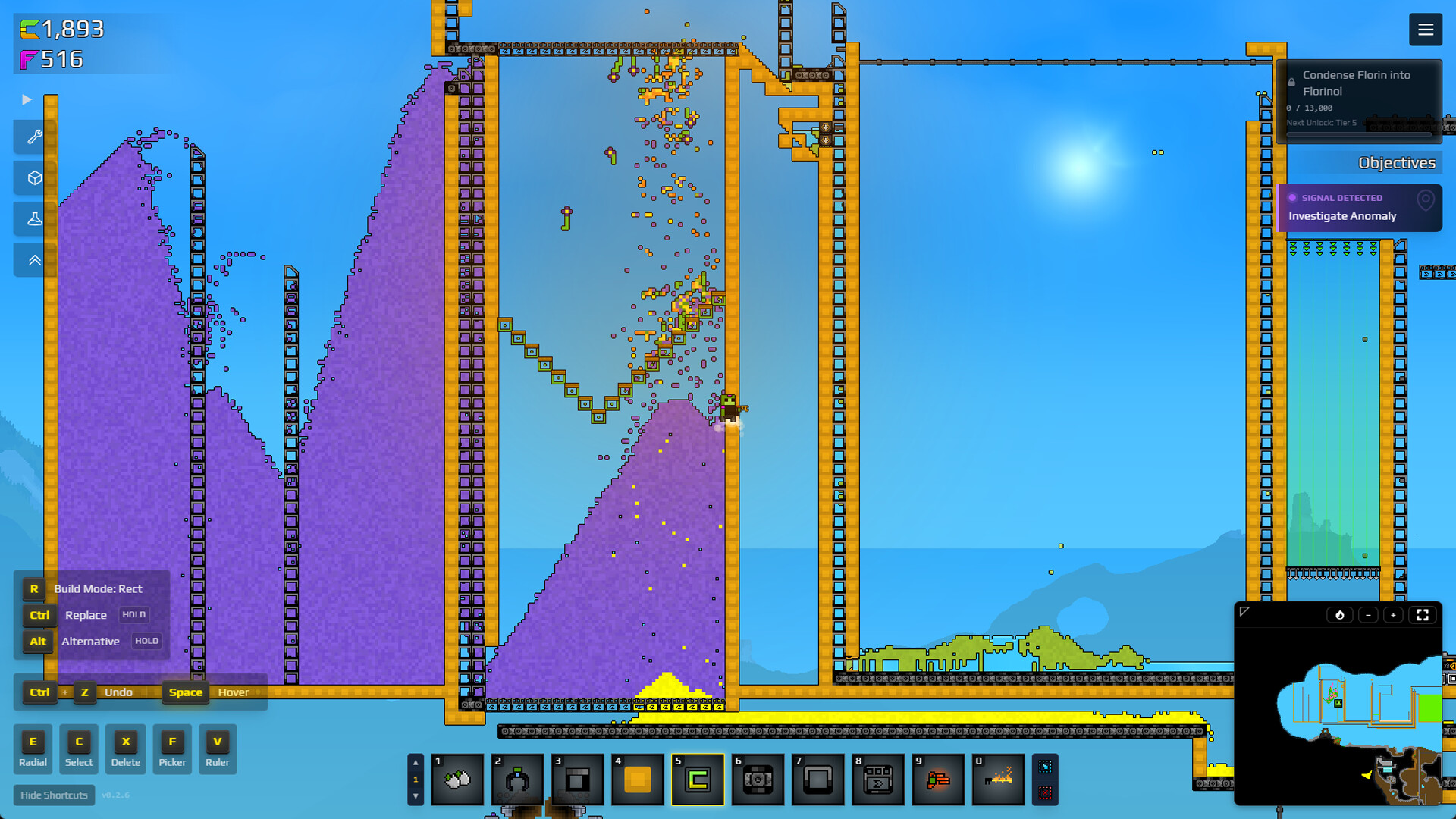
The mark of a mature Sandustry processing plant is boredom: every stream has a home, every machine eats at its own pace, and your only job is choosing what to build next. If your plant feels exciting, something on this page is still unfixed.
Watch it in action
FAQ
What is a processing plant in Sandustry?
The whole chain that turns raw digging into spendable output: sand is wetted into wet sand, shakers split it into gold and slag, slag burns into burnt slag, and the Kinetic Slag Press converts that into more gold plus spores. A 'plant' is that chain laid out so nothing jams.
How many shakers can one water setup feed?
Community ratio guides suggest one wetting point comfortably feeds one to two shakers early, and recommend adding water capacity before a third shaker row — doubling shakers without doubling water adds nothing.
How much gold comes out of a shaker?
Community testing lands around a fifth to a quarter gold from each wet-sand batch, and the bulk of the remainder leaves as slag. Treat the exact figure as patch-sensitive and judge your own line by watching an output tile for a minute.
When should I add a second Kinetic Slag Press?
Only when burn capacity already meets or exceeds slag production. A press with no burnt slag arriving is Refining 2 gold sitting idle; a second press fed by the same starved burn lane changes nothing.
Belts or drones for plant logistics?
Belts for steady short routes like wet sand to shakers; drones for vertical or temporary hauls. Community advice is blunt: several drones plus one belt beats a drone swarm fed by nothing.
What should I build first in a new Sandustry processing plant?
Storage and the spine: an oversized intake box with a belt floor, then a single conveyor main line with filter stages peeling one material each. Processing wings attach to the spine after storage exists.
Sources
- sandustry.wiki: production chain setuphttps://sandustry.wiki/production-chains/production-chain-setup/
- sandustry.wiki: production line guidehttps://sandustry.wiki/production-chains/production-line/
- sandustry.wiki: materials hubhttps://sandustry.wiki/materials/
- sandustry.wiki: production ratio helperhttps://sandustry.wiki/tools/production-ratio-helper/
- sandustry.wiki: slag processinghttps://sandustry.wiki/guides/slag-processing/
- Twisted (HoneyBunnyGames) factory engineering run (captions)https://www.youtube.com/watch?v=Joc66925_Ok
- Official Sandustry sitehttps://sandustry.com/
- Sandustry on Steam (app 2764460)https://store.steampowered.com/app/2764460/Sandustry/