sandustry · sandustry slag burner
Sandustry Slag Burner: Setup & Outputs
Last verified: 2026-08-15
A Sandustry slag burner is a process you assemble, not a machine you unlock: apply sustained heat to Slag until every piece converts to Burnt Slag, the only feedstock the Kinetic Slag Press accepts. This page walks the whole Sandustry slag burner loop — what goes in, what comes out, where the burn zone belongs, and how to clear the pile-ups every recorded build eventually hits.
What goes in, and what comes out
Every shaker produces slag alongside gold — community testing puts gold at roughly a fifth to a quarter of the wet sand fed in, and the rest leaves as slag. If your factory makes gold, it is already feeding the input side of a Sandustry slag burner whether you planned for one or not. Three input-side rules come out of captured builds:
- Slag sinks. It drops through sand and wet sand in mixed columns, which helps passive sorting but buries whatever shares its landing tile. Move slag sideways with conveyors before it falls into a common pit, and never let it share a drop chute with gold without a filter between them — buried gold is the classic reason research feels slower than shaker yield predicts.
- Unburnt slag blocks fire spread. A raw backlog parked at the edge of the burn zone shields the pile behind it, so clear the lane before scaling up digging.
- Buffer before you burn. A silo or holding pad between the shaker output and the burn lane absorbs digging spikes, so the flame zone sees a steady feed instead of a flood.
The output side is far smaller than the input: recorded burns show a six-block-deep slag pile shrinking to under two blocks of burnt slag, which makes a Sandustry slag burner your best compaction tool as well as your only path into press recipes. Burnt slag drops through the press and breaks into gold and spores — the mid-game research economy in a single step.
Method 1 — The flamethrower (manual)
The manual Sandustry slag burner is just Tools 1: the flamethrower converts slag on contact:
- Aim at a slag pile and hold; pieces catch, burn, and come out the other side as burnt slag.
- Conversion is per-piece and takes time inside the flame. A fast belt full of slag will outrun a stationary flame; sweep the fire across the whole stream or slow the stream down.
- Deep piles insulate themselves — the top layer rides across the flame untouched while the bottom converts, which is why manual burns finish unevenly.
Manual burning never fully goes away — even automated lines keep a flamethrower on the hotbar for pile-ups and restarts.
Method 2 — The lava bed (automatic)
Since lava cannot be piped, the standard Sandustry slag burner brings the slag to the heat instead. The cinder detour is the whole trick: freeze lava with the cryoblaster into cinder, a powder that rides conveyors, launchers, and filters like any solid, then melt it back down where the burn floor should be.
- Lay a row of filters set to allow only cinder, where you want the burn floor.
- Pack them completely with cinder — the bed only works when it is full, because the lava level has to reach the top of the filter row. Drop spare cinder back onto the feed belt until no gap remains.
- Seal the bed: solid blocks around it and conveyor belts where containment needs a floor, since belts block fluids. Mind the corners — lava, like water, can slip through diagonal gaps, and one open corner drains the whole bed.
- Ignite the cinder with the flamethrower until the whole bed melts into lava. Check the block tops for dark spots; anything not glowing is still cinder and will leave a cold strip in the lane.
- Run the slag stream over the lava. Pieces convert as they cross; the heat source never moves again.
Two operational warnings from recorded builds:
- Keep water away from the bed — above it as well as beside it. Water meeting lava flashes to steam, the steam climbs and rains back down, and the cycle keeps spitting water onto your burn zone. Roof the steam paths or move the water.
- Deep slag piles shield themselves. The top of a thick pile can cross the lava unburnt. Feed the bed a thin stream and route survivors back around for a second pass.
Placement: where the burn zone belongs
Siting decides most of a Sandustry slag burner's reliability, and recorded factories converge on the same rules:
- Build directly downstream of the shakers. Raw slag is the bulkiest material in the loop; the shorter its unburnt leg, the less there is to jam. Burnt slag is compact, so the long belt belongs after the burn.
- Let gravity feed the bed. A burn floor sunk one level below the shaker line needs no launchers on the input side — slag slides across the flame and drops through the far end.
- Reserve a return lane. Pieces that cross unburnt need a loop back to the start of the bed; builds without one quietly accumulate raw slag at the press.
- Keep the surroundings dry. No reservoirs overhead, no steam chimneys aimed at the roof, and enough light that you can spot an unburnt trickle before it becomes a pile.
Sizing the burner to the line
Burn throughput is governed by how much slag is inside the flame zone at any given moment, and both failure directions are real:
- Under-fed: the burner idles and the press starves — a mining or wetting problem, not a burn problem.
- Over-fed: slag crosses the flame unconverted and arrives at the press raw, where every stray piece is a future jam.
The control valve is a buffer: a slag silo or holding pad between the shaker output and the burn lane absorbs digging spikes and lets the Sandustry slag burner run at a constant, winnable rate. If slag production durably outgrows the lane, pause shaker expansion until burn capacity catches up — adding shakers just relocates the backlog.
Troubleshooting piles, stalls, and half-burnt streams
When a Sandustry slag burner misbehaves, the symptom tells you where to look:
- Raw slag reaching the press: the stream is too thick or too fast. Cap the incoming belt height, spread the feed across a wider bed, and recirculate whatever survives.
- The bed stopped converting: check for water incursion first, then for matting — a carpet of raw slag riding over the lava on top of earlier pieces. Clear the lane by hand and restart thin.
- Backlog at the shaker output: the buffer is full and the burn lane is the bottleneck. Do not add shakers; widen the bed or lengthen flame contact instead.
- Everything works, just slowly: belts are the pacing item. Recorded builds add parallel belts on the burnt-slag leg before touching anything about the fire.
Where the burnt slag goes
Drop it through the press, one piece at a time — the drop window, anti-jam geometry, and output drainage are all in the Kinetic Press guide. The one rule that belongs on this page: what the press misses can be re-dropped until it converts, so build a recirculating return under the press rather than a disposal pit. For the wider plant context — ratios, buffers, expansion order — see the Processing Plant guide. A Sandustry slag burner that ends in a clean press loop is the point where a gold factory becomes a research factory.
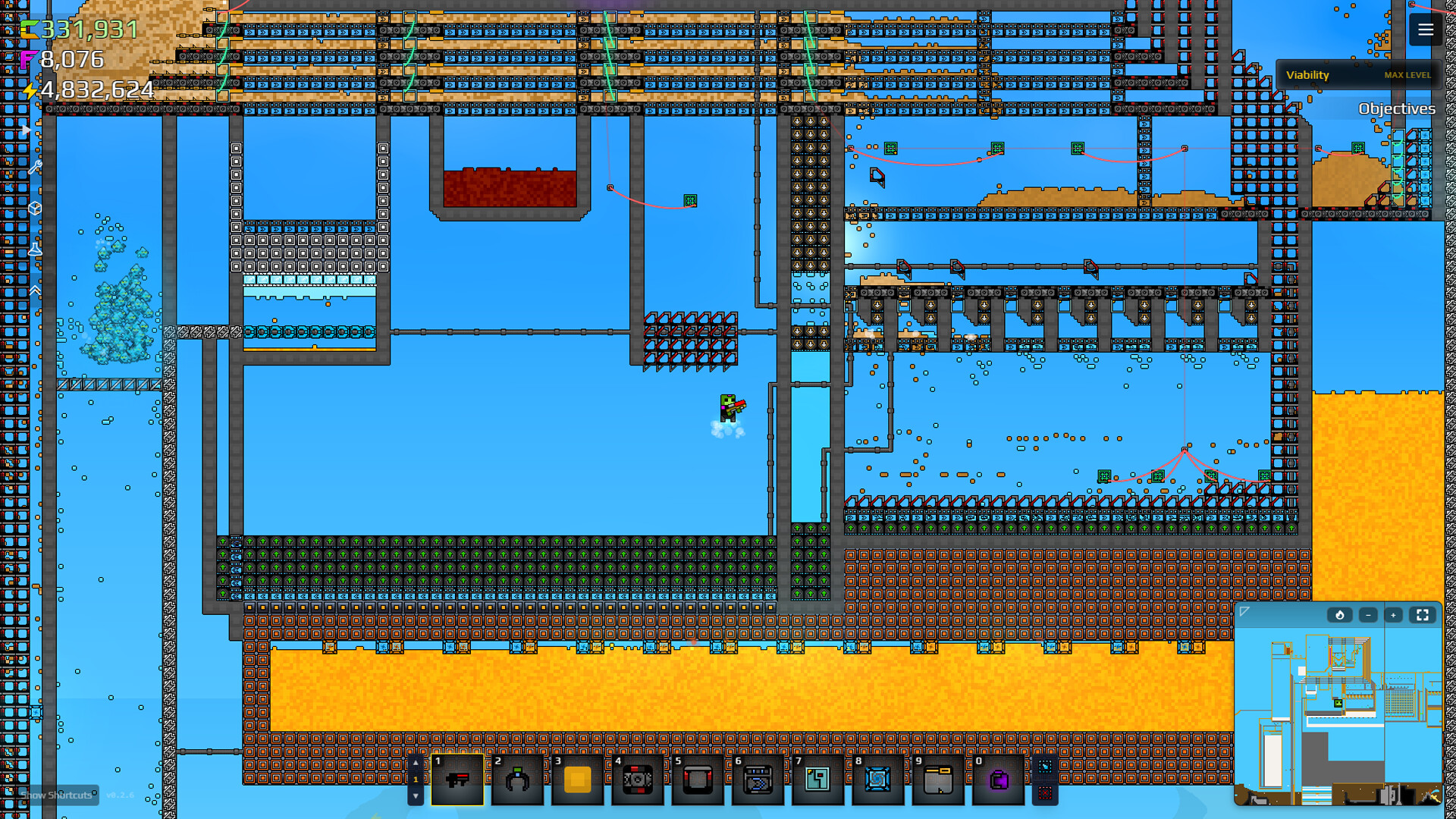
Watch it in action
FAQ
Is there a Slag Burner building in Sandustry?
No. 'Slag burner' describes a process, not a machine: sustained heat — a flamethrower flame or a lava bed — converts slag into burnt slag. You assemble the burner out of terrain, filters, and a heat source.
How do I burn slag?
Point the Tools 1 flamethrower at a slag pile and keep it burning until the pieces convert. To automate it, pack a filter completely with cinder, seal it against leaks, ignite the cinder into lava, and run your slag stream across that lava bed.
Why is some slag reaching my press unburnt?
Burning is not instant — conversion depends on how much slag is inside the flame at one time. Deep piles insulate their own top layer, so the upper pieces ride through unconverted. Spread the stream thinner, slow it down, or lengthen the burn lane and recirculate the survivors.
Can I pipe lava to my burner?
No — pipes carry water only. The community workaround is the cryo chain: freeze lava into cinder (a conveyable powder), belt it to the destination, and melt it back down with the flamethrower.
What are the exact burn temperatures and recovery rates?
There are none in the actual game. Sandustry has no numeric temperature system — conversion is by flame contact. Any site quoting Celsius ranges or percentage tables for slag burning is publishing invented figures.
How much space does a slag burner save?
A lot. Recorded burns show a six-block-deep slag pile shrinking to under two blocks of burnt slag, so burning is compaction as well as conversion. If your slag pit keeps swallowing belts, the missing piece is usually a burn lane, not a bigger pit.
Sources
- sandustry.wiki: Gold and Slaghttps://sandustry.wiki/materials/gold-slag/
- sandustry.wiki: production line guidehttps://sandustry.wiki/production-chains/production-line/
- Sandustry Toolkit: fix a jammed slag presshttps://sandustry.hunt-games.com/how-to/fix-kinetic-slag-press-jam/
- Sandustry Toolkit: move lava and steam without pipeshttps://sandustry.hunt-games.com/how-to/move-lava-and-steam-without-pipes/
- Nonsanity: Slag Burning and Spore Washing (captions)https://www.youtube.com/watch?v=bBEzp9Bf2Os
- sandustrywiki.wiki slag page (values rejected — see note below)https://www.sandustrywiki.wiki/materials/slag
- Official Sandustry sitehttps://sandustry.com/
- Sandustry on Steam (app 2764460)https://store.steampowered.com/app/2764460/Sandustry/
- Official launch trailerhttps://www.youtube.com/watch?v=-m7xp1q24Qw